

Flu season is like that party guest who shows up late, stays way too long, and causes chaos. While it usually crashes between fall and winter, the flu doesn’t always show up on time. October is when the drama typically starts, but the virus really peaks between December and February. And, just like with everything else, COVID has messed with this schedule, making it a little less predictable these days.
For 40 years, February has taken the top spot as flu’s favorite month, leading the charge 17 times. December is a close second. If you’re wondering how we know all this, it’s because of FluView, the CDC’s weekly tracker that keeps an eye on the flu, ensuring we’re not caught off guard.
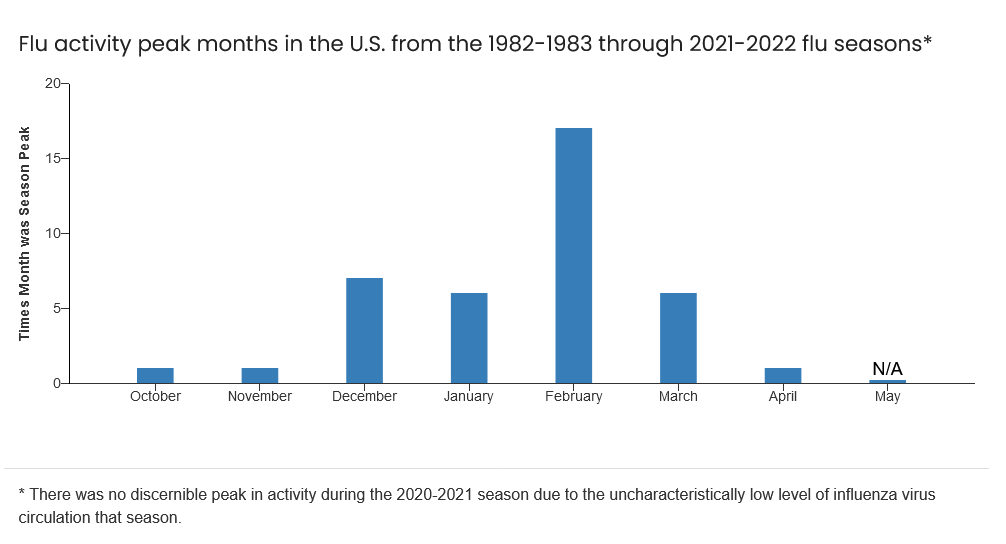
https://www.cdc.gov/flu/about/season/index.html
When Should You Get Your Flu Shot?
Your flu shot isn’t magic. It takes 10 to 14 days after getting the vaccine for your body to build up its defense against the virus. That’s why most places start rolling out flu shots in early autumn. Since the flu season rarely starts before mid-November, this timing gives your immune system plenty of time to gear up for battle. The flu season itself can stretch all the way into May, so getting that vaccine early is key to staying protected through the long months ahead.
But the COVID-19 pandemic has thrown a curveball into the mix. The usual seasonal pattern for flu might be shifting, with COVID co-circulating and complicating things. So, while the flu shot still offers solid protection, it’s good to stay on your toes.
How Long Does Flu Shot Protection Last?
The flu vaccine is like a seasonal shield — it protects you for about 6 to 8 months. The clock starts ticking two weeks after you get the shot, so if you want to be covered for the whole season, aim to get vaccinated by early fall.
However, the vaccine’s effectiveness does drop off over time. This is partly because your immunity fades and partly because the flu virus itself is a master of disguise, constantly changing its form through what scientists call “antigenic drift.” It’s like trying to hit a moving target, so staying up-to-date on your vaccine each year is essential.
Why the Flu Shot Is Still Worth It
Even though your flu shot’s powers might wane over time, it’s still your best defense against a nasty infection. It won’t last forever, but it gives you solid protection for the current season. Plus, in the post-COVID world, with the possibility of co-infections and new viral challenges, getting the flu shot can help reduce your risk of severe illness.
Bottom line: Get your flu shot early, stay protected, and keep an eye on FluView to track how the season’s shaping up. After all, you don’t want to be caught unprepared for the viral chaos ahead.
Stay sharp and get that flu shot!
https://www.ecdc.europa.eu/en/seasonal-influenza/prevention-and-control/vaccines/timing
Hu W, Sjoberg PA, Fries AC, DeMarcus LS, Robbins AS. Waning Vaccine Protection against Influenza among Department of Defense Adult Beneficiaries in the United States, 2016-2017 through 2019-2020 Influenza Seasons. Vaccines (Basel). 2022 Jun 1;10(6):888. doi: 10.3390/vaccines10060888. PMID: 35746496; PMCID: PMC9229659.
Bi Q, Dickerman BA, Nguyen HQ, Martin ET, Gaglani M, Wernli KJ, Balasubramani GK, Flannery B, Lipsitch M, Cobey S; US Flu Vaccine Effectiveness Network Investigators. Reduced effectiveness of repeat influenza vaccination: distinguishing among within-season waning, recent clinical infection, and subclinical infection. medRxiv [Preprint]. 2024 Apr 10:2023.03.12.23287173. doi: 10.1101/2023.03.12.23287173. Update in: J Infect Dis. 2024 Apr 30:jiae220. doi: 10.1093/infdis/jiae220. PMID: 37016669; PMCID: PMC10071822.
 The Pharmers Almanac