
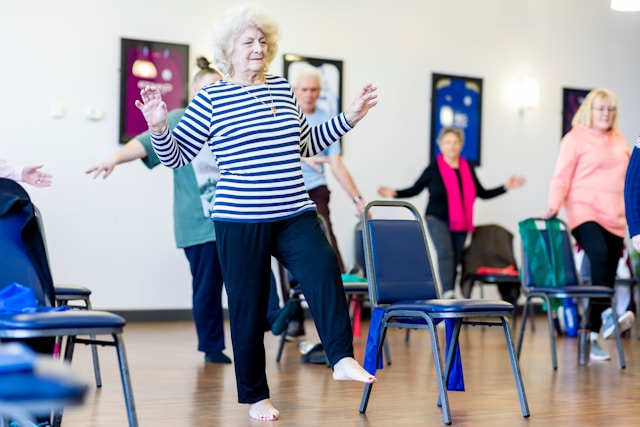
Let’s break it down: the best exercises for bone density in postmenopausal women (PMW), based on the latest science. We’ll group them by type, with a cheat sheet at the end.
🏋️♀️ 1. Resistance Training (RT)
Think: weight lifting, resistance bands, bodyweight exercises (like squats or push-ups)
Why it works:
Bones love pressure. When you lift weights, you’re telling your bones, “Hey, get stronger!” The pressure triggers bone-building cells (osteoblasts) to kick into gear.
How to do it:
- 2–3 times/week
- Focus on big muscle groups: legs, back, arms
- Example: squats, lunges, dumbbell rows, resistance band chest press
🏃♀️ 2. Aerobic Exercise (AE)
Think: brisk walking, jogging, dancing, cycling
Why it works:
Aerobic exercise helps regulate hormones, especially estrogen. That’s key because estrogen loss is the main bone-density villain in menopause.
How to do it:
- 30–45 minutes, 3–5 times/week
- Aim for moderate intensity: you should be breathing harder, but still able to talk
💪🔥 3. AE + RT Combo (The Power Move)
Think: 20 minutes of cardio + 20 minutes of weights in one session
Why it works:
Studies show this combo delivers the biggest boost in bone density—especially in the spine and hips, the most fracture-prone areas.
How to do it:
- Mix it up: do a circuit (ex: 10 min treadmill → strength → repeat)
- Try a fitness class or YouTube routine combining both
- Do it 3x/week for serious gains
⚡️ 4. Whole Body Vibration (WBV)
Think: standing on a platform that gently vibrates your whole body
Why it works:
Vibration stimulates bone growth in the legs and hips—without the need for heavy lifting. Great for those with joint pain or limited mobility.
How to do it:
- 15–20 minutes, 2–3 times/week
- Make sure it’s a medical-grade or trainer-guided setup (not just a random shake machine)
🧘♀️ 5. Tai Chi & Walking (Still good—but not for bone gains)
Why they’re still useful:
They improve balance, coordination, and reduce fall risk (which helps prevent fractures). But they won’t build bone.
Do it for:
- Stability
- Mental wellness
- Fall prevention
🧠 CHEAT SHEET: Best Exercises for Bone Density in PMW
| Goal | Best Exercise(s) | Notes |
|---|---|---|
| Build bone density | AE + RT 🥇 | The gold standard |
| Spine strength | Resistance Training, AE | Target back and core |
| Hip & leg strength | WBV, AE + RT | Especially for femur neck |
| Balance & fall prevention | Tai Chi, Walking | Good support exercises |
| Low impact options | WBV, resistance bands | For joint issues |
Key references:
- Li et al. (2024): AE + RT significantly improved spine, thigh, and whole-body BMD
- Hejazi et al. (2023): AE + RT outperformed single-modality exercises
- de Oliveira et al. (2022): Confirmed AE + RT’s superior outcomes in multiple bone sites
- Dutto et al. (2023): High-intensity RT beat moderate-intensity for spine BMD
- Weycker et al. (2022): Showed increases in BMD across multiple skeletal regions
- Kelley et al. (2019): Strength training increased BMD, especially when done >2x/week
- Rahimi et al. (2021): AE showed significant lumbar BMD improvements
- Ettinger et al. (2020): AE increased estrogen and reduced bone resorption
- Gába et al. (2018): AE improved bone indicators better than tai chi or walking
- Rahimi et al. (2021): WBV improved femur BMD
- de Oliveira et al. (2022): WBV = effective as aerobic for BMD
- Riaz et al. (2020): WBV increased strength and reduced fracture risk in older adults
- Woo et al. (2020): Tai Chi slowed bone loss, not statistically significant
- Chan et al. (2019): Tai Chi group had slower trabecular bone loss
- Kelley et al. (2017): Brisk walking improved some bone regions, but not lumbar spine
 The Pharmers Almanac